
| Panel 2025 | |||
|---|---|---|---|
| Pharmaceutical | FMCG | Luxury | |
| 3 French companies |
Kering LVMH EssilorLuxottica |
||
| 5 European companies (excl. France) |
GSK Novartis |
Beiersdorf Unilever Henkel |
|
| 5 US companies |
Colgate Palmolive Pepsico Procter & Gamble Kenvue (Johnson&Johnson) |
Estée Lauder | |
| Total 13 companies | 2 | 7 | 4 |

| 2026 Adjusted panel | |||
|---|---|---|---|
| Pharmaceutique | FMCG | Luxury | |
| 3 French companies |
Kering LVMH EssilorLuxottica |
||
| 5 European companies (excl. France) |
GSK Novartis |
Beiersdorf Unilever Henkel |
|
| 4 sociétés américaines | Colgate Palmolive Pepsico Procter & Gamble |
Estée Lauder | |
| Total 12 companies | 2 | 6 | 4 |
Company exiting the 2026 Panel
Following this adjustment, L'Oréal is well positioned in the benchmark panel for the key indicators. Based on data available at end-September 2025, the Group is positioned (i) between the median and the third quartile for sales (59%), (ii) in the third quartile for market capitalisation (76%), based on L’Oréal’s capitalisation at 31 December 2025, and (iii) between the median and the third quartile for headcount at 31 December 2024 (58%).
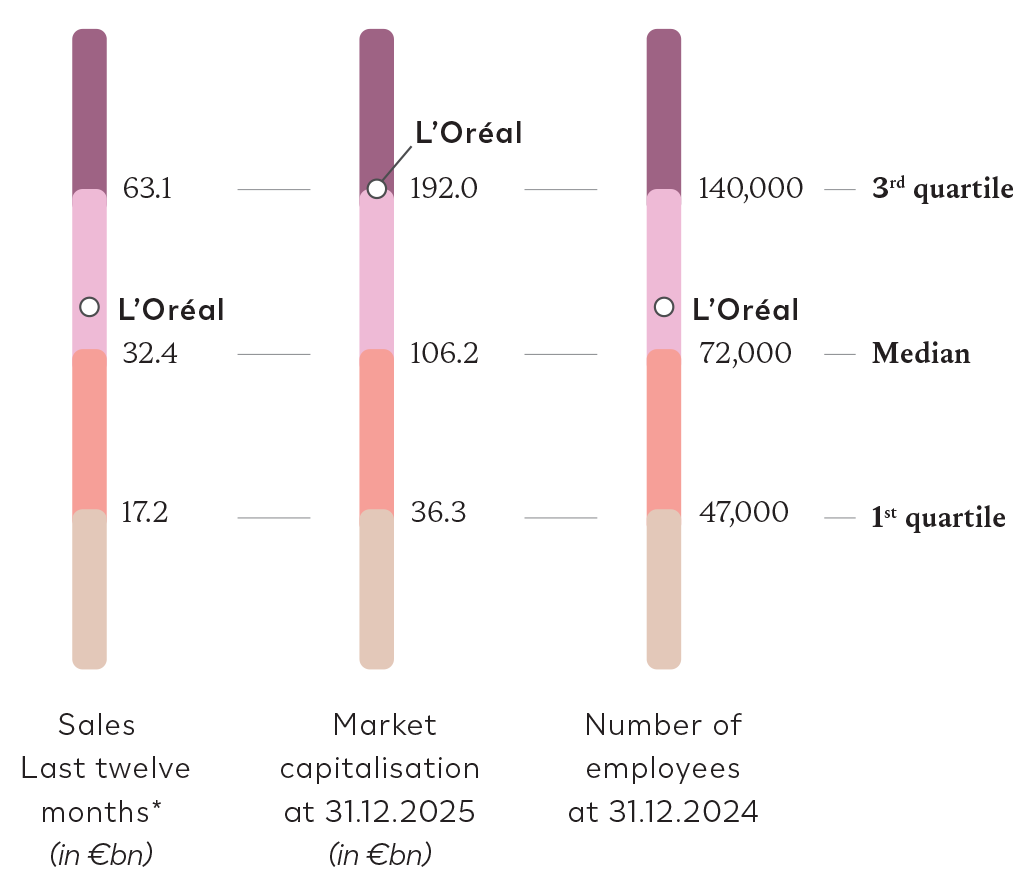
This chart shows L'Oréal's position relative to the quartiles of its peer group based on three key indicators: Sales , market capitalisation, and number of employees.
Sales Last twelve months* (in billions of euros):
3rd Quartile: €63.1 billion
Median: €32.4 billion
1st Quartile: €17.2 billion
L'Oréal’s Position: at the median level, or approximately €32.4 billion
Market capitalisation as of 31.12.2025 (in billions of euros):
3rd quartile: €192.0 billion
Median: €106.2 billion
*Last twelve months: total sales from 01.10.2024 to 30.09.2025.
Remuneration that is aligned with the best interests of the Company and directly linked to its strategy
The Board of Directors aligns the remuneration policy for the executive corporate officer with the interests of the Company in order to ensure its long-term sustainability and development, taking into consideration the social and environmental challenges of its business activity and L'Oréal's Sense of
Purpose.
a) Close links with strategy
The remuneration policy applied to the executive corporate officer is directly linked to the Group's strategy. It supports its development model. It promotes harmonious, regular, durable growth, both over the short and long term. The Board of Directors strives constantly to encourage General Management to maximise performance for each financial year and to ensure that this performance is repeated and regular year after year. This is in line with L'Oréal's objective of economic and societal excellence.
b) Performance targets that are directly correlated with those of the Company and create value
The Board of Directors chooses to correlate executive corporate officer's performance directly with the Company's performance by using the same performance indicators, and in particular financial indicators.
The choice of correlating the performance criteria for the executive corporate officer's remuneration with the Company's performance indicators, particularly those of a financial nature, serves as a guarantee of a clear and relevant remuneration policy.
These criteria make it possible to use internal performance indicators to assess L'Oréal's intrinsic performance, namely its year-on-year progress, as well as its relative performance as compared to the market and its competitors through external growth indicators.
The objectives adopted generate long-term value creation. In particular, the choice of varied operational financial criteria aims at encouraging durable, balanced growth. Overall long-term performance results from the convergence of these criteria.
These objectives must also be an incentive for the executive corporate officer to adapt the Group's strategy to the profound transformations in the world of beauty, and in particular the digital revolution.
c) Major portion of remuneration subject to performance conditions
A major component of executive corporate officer remuneration must be subject to performance conditions, with annual and multi-annual assessment periods adapted to the time horizon of each of these objectives.