
Remuneration that is directly aligned with the Group's ambitious social, societal and environmental objectives
The remuneration must promote ongoing and sustainable development, in line with the Group's commitments with regard to ethics, and be respectful of the environment in which L'Oréal operates. In 2020, L'Oréal unveiled its 2030 Corporate Social Responsibility vision as part of the L'Oréal for the Future programme. At the General Meeting held on 29 April 2025, i.e., halfway through the programme, L'Oréal presented a number of adjustments to its roadmap and introduced new objectives. The social and societal commitment is just as important since no environmental transition is possible without an inclusive society.
The annual variable portion of executive corporate officer remuneration, and their long-term remuneration, includes non-financial criteria related to L'Oréal's Sense of Purpose and the objectives defined by the Group, particularly in the context of its corporate social, societal and environmental responsibility programmes.
These criteria will be assessed year-on-year with a long-term perspective.
Remuneration that creates medium- and long-term value for shareholders
Executive corporate officer remuneration must be linked to the medium‑to long-term variation in the Company's intrinsic value and share performance. A significant proportion of the executive corporate officer's remuneration therefore consists of performance shares.
50% of the performance shares granted to the Chief Executive Officer, with a four-year vesting period, are subject to a further holding period of two years. This holding period still applies in the case where the beneficiary ceases to be Chief Executive Officer before the end of the holding period. If the beneficiary continues to exercise his function as Chief Executive Officer beyond the end of the holding period, he will be required to hold his shares in registered form until the termination of his duties in accordance with section (II) of Article L. 225-197-1 of the French Commercial Code. The executive corporate officer formally undertakes not to enter into any risk hedging transactions with regard to the performance shares until the end of the holding period set by the Board of Directors.
This leads to alignment with the shareholders' interests, which serves as long-term value creation.
B/ Policy on fixed and variable remuneration and granting of performance shares to the executive corporate officer
The key for allocating target annual remuneration
The annual remuneration of the executive corporate officer consists of annual fixed remuneration, annual variable remuneration and the granting of performance shares.
It does not include any exceptional components.
The Board of Directors adopts the various components of this remuneration, paying attention to the necessary balance between each of them.
Each component of the target annual remuneration corresponds to a well-defined and clearly substantiated objective.
The various components of annual remuneration therefore form a balanced whole, breaking down approximately as follows:
- 46/54 between fixed remuneration and target annual variable remuneration(1) ;
- 50/50 between annual remuneration and long-term remuneration (performance shares)(2) ;
- 50/50 between cash remuneration and share-based remuneration; and
- 77/23 between remuneration subject to performance conditions and remuneration not subject to performance conditions.
DIAGRAM SHOWING THE BALANCE BETWEEN THE DIFFERENT COMPONENTS OF THE ANNUAL REMUNERATION
AT TARGET LEVEL
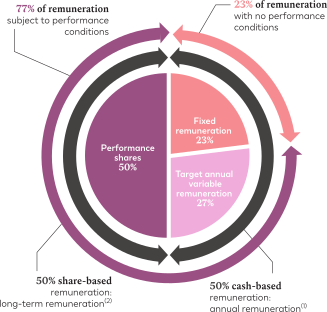
This is a diagram showing the balance between the different component of the annual remuneration at the target level.
23% of remuneration with no performance conditions
Fixed remuneration 23%
77% of remuneration subject to performance conditions
- Performance shares 50%
- Target annual variable remuneration 27%
50% share-based remuneration: long-term remuneration(2)
Performance shares 50%
50% cash-based remuneration: annual remuneration(1)
- Fixed compensation 23%
- Target annual variable compensation 27%
AT MAXIMUM LEVEL
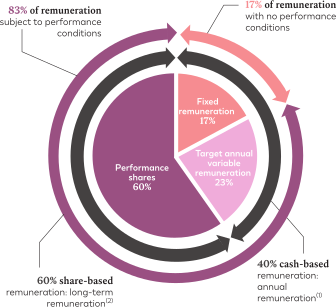
This is a diagram showing the balance between the different component of the annual remuneration at maximum level.
17% of remuneration with no performance conditions
Fixed remuneration 17%
83% of remuneration subject to performance conditions
- Performance shares 60%
- Target annual variable remuneration 23%
60% share-based remuneration: long-term remuneration (2)
Performance shares 60%
40% cash-based remuneration: annual remuneration (1)
- Fixed compensation 17%
- Target annual variable compensation 23%
N.B.: the employer's contributions to the additional social protection plans are to be added to the above.