
Fixed remuneration
The fixed remuneration must reflect the responsibilities of the executive corporate officer, his/her level of experience and skills.
It has remained stable for several years and may be reexamined at the time of their reappointment. It serves as a basis to determine the maximum percentage of the target annual variable remuneration.
Annual variable remuneration
The target annual variable remuneration represents 113% of the fixed compensation.
The annual variable remuneration may exceed 113% of the fixed compensation and represent up to a maximum of 130.4% in the event of outperformance. Outperformance is assessed on a criterion-by-criterion basis.
The aim is not to encourage inappropriate and excessive risk taking. For this purpose, the annual variable remuneration remains reasonable in comparison with the fixed portion.
The variable remuneration is designed to align the executive corporate officer's remuneration with the Group's annual performance and to promote the implementation of its strategy year after year.
The variable remuneration is based on precise performance appraisal criteria determined at the beginning of the year by the Board of Directors.
These criteria are financial, non-financial and qualitative.
The financial and non-financial criteria are simple and quantifiable. They represent a predominant portion of the annual variable remuneration. A limit is set on the qualitative portion.
The weighting of each of the criteria and the objectives to be met are set at the beginning of the year in question and communicated to the executive corporate officer.
DETAILS OF WEIGHTING OF ANNUAL VARIABLE REMUNERATION
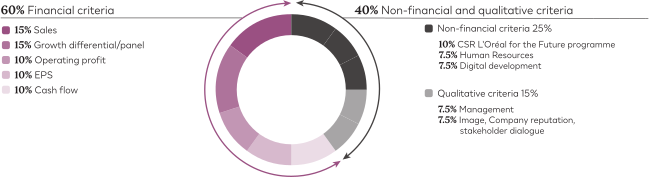
This diagram presents the details of the weighting of annual variable remuneration criteria, in the form of a donut chart.
60% Financial criteria:
- Sales: 15%
- Growth differential/panel: 15%
- Operating profit: 10% EPS: 10%
- Cash flow: 10%
40% Non-financial and qualitative criteria:
- Non-financial criteria 25%:
- CSR L'Oréal for the Future programme: 10%
- Human Resources: 7.5%
- Digital development: 7.5%
- Qualitative criteria 15%:
- Management: 7.5%
- Image, Company reputation, stakeholder dialogue: 7.5%
The quantifiable, financial (60%) and non-financial (25%) criteria account for 85% of annual variable remuneration.
Annual financial objectives
These objectives represent 60% of the annual variable remuneration and are directly correlated with the Company's performance indicators:
- change in like-for-like sales as compared to the budget (15%);
- change in market share compared to that of key competitors (15%);
- change in consolidated operating profit as compared to the budget (10%);
- change in earnings per share as compared to the budget (10%); and
- change in cash flow to net profit ratio (10%).
Minimum values (floors) have been set for each criterion, and if performance is below the floors no amounts are due. This ensures that underperformance is penalised at least as harshly as outperformance is rewarded, with no possibility of offsetting between criteria.
The Board of Directors has decided to base the Chief Executive Officer's remuneration on the Company's key performance indicators to ensure full alignment between the Group's growth strategy and the management of its operations. As most of these indicators derive directly from the internal budget, the disclosure of quantified targets (either on an ex ante or ex post basis) would reveal growth assumptions and market strategies that absolutely need to remain confidential in order to protect L’Oréal’s interests.
In order to meet investors' expectations without jeopardising the confidentiality of L'Oréal's internal data, the Board has decided to adopt a differentiated approach. From now on, the payment scale for the criterion of “sales growth differential as compared to main competitors” will be published on an ex ante and ex post basis (see following page). This criterion, which is based on relative performance rather than internal budget data, increases the transparency of remuneration without disclosing the Company's forward-looking information.
Annual non-financial and qualitative objectives
These objectives represent 40% of the annual variable remuneration and include the following:
- non-financial criteria, linked in particular to:
- the progress of the L'Oréal for the Future programme, which brings together L'Oréal's sustainability objectives for 2030 (10%),
- the implementation of the Human Resources policy with special attention to the development of gender balance in management bodies (7.5%), and
- the digital development policy (7.5%);
- qualitative criteria (15%).