
The total annual target compensation for 2025 is positioned between the first quartile and the median of the panel (relative positioning: 41%), while the theoretical maximum total annual remuneration is slightly below the median (relative positioning: 48%).
POSITIONING OF ANNUAL CASH REMUNERATION (1) ANNUELLE (2) (in millions of euros)
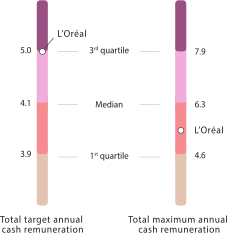
This diagram presents the positioning of L'Oréal's annual cash remuneration (see notes 1 and 2) (in millions of euros), compared to market quartiles, for two scenarios: target remuneration and maximum remuneration.
Total target annual cash remuneration:
- 3rd quartile: 5.0 M€
- Median: 4.1 M€
- 1st quartile: 3.9 M€
- L'Oréal positioning: at the 3rd quartile level, 5.0 M€
Total maximum annual cash remuneration:
- 3rd quartile: 7.9 M€
- Median: 6.3 M€
- 1st quartile: 4.6 M€
- L'Oréal positioning: between the 1st quartile and the median, approximately 5.5 M€
POSITIONING OF TOTAL REMUNERATION(3), TARGET REMUNERATION AND MAXIMUM REMUNERATION (2) (in millions of euros)
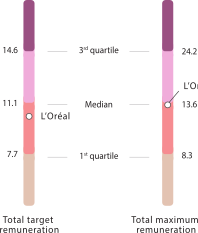
This diagram presents the positioning of L'Oréal's total target remuneration and maximum remuneration (in millions of euros), compared to market quartiles.
Total target remuneration:
- 3rd quartile: 14.6 M€
- Median: 11.1 M€
- 1st quartile: 7.7 M€
- L'Oréal positioning: at the median level, approximately 10.9 M€
Total maximum remuneration:
- 3rd quartile: 24.2 M€
- Median: 13.6 M€
- 1st quartile: 8.3 M€
- L'Oréal positioning: at the median level, 13.6 M€
The studies conducted with the independent consultancy firm also enable the Committee to measure:
- the competitiveness and comparability of the overall remuneration versus this benchmark panel;
- the relevance over time of the overall remuneration structure and the objectives assigned;
- L'Oréal's comparative results in light of the criteria adopted by the Group to assess the executive corporate officer's performance; and
- the link between the executive corporate officer's remuneration and his or her performance.
Non-executive corporate officer
To determine the positioning of the Chairman's remuneration, a panel was defined with the help of an independent consultancy firm. It comprises 16 international companies, selected on the basis of governance, industry, size and nationality.
They are the following dual governance companies:
| PANEL SELECTED FOR ANALYSIS OF THE POSITIONING OF THE REMUNERATION FOR THE CHAIRMAN OF THE BOARD OF DIRECTORS | ||||||
|---|---|---|---|---|---|---|
| AstraZeneca | AB In Bev | BASF | Bayer | Coty | Diageo | |
| Estée Lauder | GSK | Henkel | Linde | Nestlé | ||
| Novartis | Reckitt Benckiser | Roche | Starbucks | Unilever | ||
The analysis of the remuneration of chairs of boards of directors of companies in the benchmark panel, which includes five companies with two-tier governance structures already included in the benchmark panel for the executive corporate officer, reports average remuneration of €1,278,284 and median remuneration of €803,080, revealing large disparities.
The Human Resources and Remuneration Committee has all the useful internal information in its possession
This information enables it to assess the performance of the Company and that of its executive corporate officer both from a financial standpoint and in non-financial areas.
The Group's annual economic and financial results are presented each year in full and exhaustively to the members of the Human Resources and Remuneration Committee, and are used as a basis for the assessment of the financial performance criteria for the executive corporate officer's variable remuneration.
The principles of the Human Resources policy are regularly presented to the Committee members or at Board of Directors meetings by the Chief Human Relations Officer. The Directors are therefore able to verify the consistency between the remuneration of the executive corporate officer and the remuneration and employment conditions of the Company's employees.
Two members of the Human Resources and Remuneration Committee are members of the Strategy and Sustainability Committee, a body where the Group's social and environmental responsibility programmes are discussed.