
To meet its target for reducing Scope 3 emissions, which account for the majority of its carbon footprint, L'Oréal has set out trajectories adapted to the transformation of each of its functions and business lines, and planned how to roll them out in collaboration with all the Divisions and Regions. Reducing Scope 3 emissions includes indirect emissions linked to the company's entire value chain, upstream and downstream of its direct operations. This includes emissions linked to the purchase of raw materials, the transportation of goods, the use of products sold, the end-of-life of these products, and business travel.
L'Oréal has consolidated these ambitions in its transition plan, which includes the levers under its direct responsibility as well as the contribution expected from suppliers reducing emissions from their activities. The main levers identified to achieve these objectives by 2030 are described in detail in section 4.2.3.2.
Beyond 2030, to prepare for the future and meet its 2050 decarbonisation ambition, L'Oréal is exploring various solutions, supported by technological developments and a favourable political context. These include:
- improving the energy mix in all countries in the value chain;
- carbon-free logistics;
- developing carbon capture technologies for raw materials; and
- new product and packaging formats.
L'Oréal also strives to minimise “locked-in” emissions, linked to the depreciation of assets designed to emit carbon irreversibly, such as certain emergency power generators or cooling systems containing refrigerants. In Scopes 1 & 2, the use of renewable energies reduces current emissions and prevents new locked-in emissions. With regard to Scope 3, even though the use of L’Oréal products does not involve direct consumption of fossil energy, their full life cycle could generate emissions that depend on the local energy mix (for example, the electricity needed to use appliances such as the “Air Light Pro” hairdryer). These emissions are recorded in the greenhouse gas emissions reports and in the transition plan. The risks associated with these locked-in emissions are considered to be limited and are not expected to compromise the Group's decarbonisation targets.
Focusing on deep decarbonisation
As part of its drive towards Net Zero, the Group's current strategy is focused on reducing emissions across its value chain. Offsetting through carbon capture will be rolled out to deal with any residual emissions (up to a maximum of 10%), gradually ramping up through to 2050.
4.2.3.2 Pulling multiple decarbonisation levers
L’Oréal is actively pursuing its 2030 decarbonisation pathway, using several major strategic levers. These efforts are structured around various action plans, aimed at reducing the Company’s carbon footprint by addressing both direct operations and the entire value chain.
Main ongoing actions related to Scopes 1 & 2
Decarbonisation efforts for Scopes 1 & 2 are focused on sites, stores and the vehicle fleet with a view to:
- improving the energy efficiency of operated sites;
- reaching 100% renewable energy use on operated sites and stores(1) ;
- continuing to electrify the vehicle fleet.
DECARBONISATION OF SCOPES 1 & 2
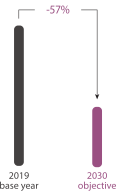
This bar chart illustrates the decarbonisation objective for Scopes 1 & 2, showing a 57% reduction in emissions between the 2019 base year and the 2030 objective.