
4.3.2.1.1 Preventing pollution-related risks through the EHS policy
The fight against air and water pollution is based on the EHS policy, which applies to all sites operated by L'Oréal and its subcontractors, with an approach built on four strategic pillars:
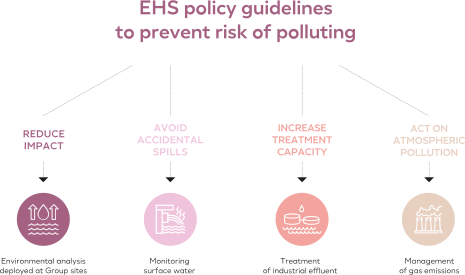
This diagram outlines the four strategic pillars of L’Oréal’s EHS (Environment, Health and Safety) policy aimed at preventing air and water pollution across its operational and subcontractor sites:
- Reduce Impact. Action: Environmental analysis deployed at Group sites.
- Avoid Accidental Spills. Action: Monitoring of surface water.
- Increase Treatment Capacity. Action: Treatment of industrial effluent.
- Act on Atmospheric Pollution. Action: Management of gas emissions.
4.3.2.1.2 Environmental assessment
All production sites conduct an environmental assessment which is updated once a year. The assessment covers all of the site's activities, including upstream and downstream processes, to identify any significant risks of water and air pollution, and to respond with an action plan. This approach is also used to reduce the impacts related to new site locations, renovation projects and changes to industrial processes. Environmental due diligence is systematically performed before any land or building acquisition.
4.3.2.1.3 Monitoring surface water
The Group ensures that its water, particularly rainwater, discharged directly into the environment is of good quality. To do so, it uses monitoring, treatment (e.g., sites are equipped with hydrocarbon separators in car park areas) and retention (e.g., at-risk storage areas must have sufficient retention capacity to contain extinguishing water in the event of a fire) methods.
4.3.2.1.4 Treating industrial effluent
A key indicator of water pollution is chemical oxygen demand (COD), which quantifies the oxygen required to chemically oxidise organic matter in water, whether biodegradable or not. A high COD means a high concentration of these substances and more polluted water. The COD test uses a powerful oxidant in an acid environment to oxidise these materials, and the quantity of oxidant consumed is converted into oxygen equivalent. This measurement is essential for assessing the effectiveness of wastewater treatment and monitoring the water quality.
The Group's production sites are required to comply with local regulations and contractual agreements for all their discharge indicators. In addition to these requirements, L'Oréal has defined an internal standard of 1,000 mg COD per litre of effluent, which is used to monitor the efficiency of its water treatment plants.. This standard defines the maximum concentration of chemically oxidisable organic matter for its discharges.. It was defined based on analyses of data on internal performance and the most modern wastewater treatment plants and of the rates observed in domestic water.
To achieve this, L'Oréal uses appropriate technologies (physical, chemical and biological processes) depending on the characteristics of the effluent. The local sites are responsible for operating the relevant equipment and managing the discharge, ensuring that there is no untreated water spill.