
Assessing environmental impacts using SPOT
As part of its sustainability drive, L'Oréal has developed the Sustainable Product Optimisation Tool (SPOT), which assesses the environmental footprint of products throughout their life cycles. Based on the European product environmental footprint benchmark, SPOT assesses 14 impact factors at each stage of the life cycle, from ingredients to use and recycling. These categories include the impact on climate change, water quantity and biodiversity.
As part of its continuous improvement approach, the data collected and the calculation method are constantly evolving. The data collected are then standardised according to the average impact of a consumer worldwide, resulting in a single overall environmental footprint for each product.
The SPOT environmental design tool helps L'Oréal teams design products with a lower environmental impact. By comparing a product's footprint with a benchmark, the teams are able to identify areas for improvement in terms of formulas and packaging.
This tool supports L'Oréal's mobilisation in favour of more responsible beauty and is part of a continuous improvement approach aimed at reducing overall environmental impact.
THE 14 IMPACT FACTORS CALCULATED AS PART OF THE SCORING AT EACH STAGE OF A PRODUCT'S LIFE CYCLE(1)
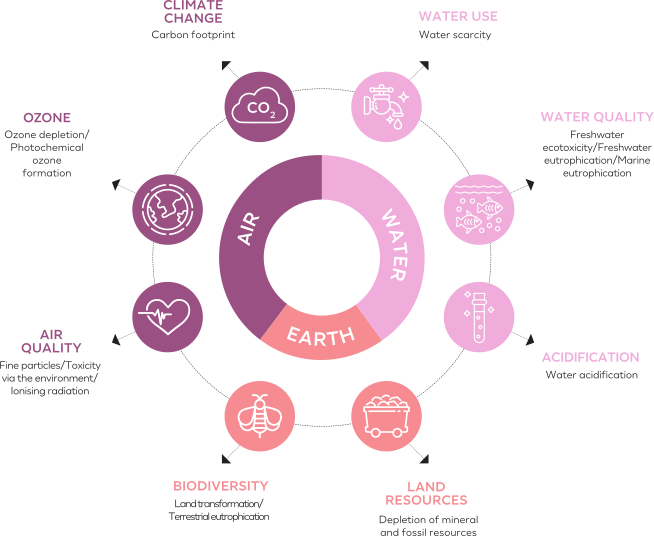
This diagram presents the 14 impact factors calculated as part of the scoring at each stage of a product's life cycle, organised around three environmental domains: Air, Water and Earth.
- Air:
- Climate Change:
- Carbon footprint
- Ozone:
- Ozone depletion
- Photochemical ozone formation
- Air Quality:
- Fine particles
- Toxicity via the environment
- Ionising radiation
- Water:
- Water Use:
- Water scarcity
- Water Quality:
- Freshwater ecotoxicity
- Freshwater eutrophication
- Marine eutrophication
- Acidification:
- Water acidification
- Earth:
- Biodiversity:
- Land transformation
- Terrestrial eutrophication
- Land Resources:
- Depletion of mineral and fossil resources
4.4.4 Outcomes related to water resources
4.4.4.1 L’Oréal for the Future ambitions for water resources
| Targets | 2025 |
|---|---|
| By 2030, L’Oréal aims to use 100% recycled and reused water for industrial purposes at its factories. | By 2030, L’Oréal aims to use 100% recycled and reused water for industrial purposes at its factories. 2025 56% |
| By 2030, L’Oréal aims to offer water-saving products or technologies to enable consumers in water-stressed markets to meet their hygiene and beauty needs. | By 2030, L’Oréal aims to offer water-saving products or technologies to enable consumers in water-stressed markets to meet their hygiene and beauty needs. 2025 57% |
4.4.4.2 CSRD disclosure requirements relating to water consumption (E3-4)
| In cu.m | 2024 | 2025 |
|---|---|---|
| Total water consumption | Total water consumption 2024 972,374 |
Total water consumption 2025 954,075 |
| Total water consumption in areas at water risk, including areas of high water stress(1) | Total water consumption in areas at water risk, including areas of high water stress (1)2024 353,639 |
Total water consumption in areas at water risk, including areas of high water stress (1)2025 383,008 |
| Total water recycled and reused | Total water recycled and reused 2024 877,222 |
Total water recycled and reused 2025 940,246 |
(1) Indicator calculated on the Group factory scope. This scope was defined in 2025 as described in the notes on methodology
| In cu.m./millions of euros | 2024 | 2025 |
|---|---|---|
| Water intensity: total water consumption per net sales on own operations(1) | Water intensity: total water consumption per net sales on own operations (1)2024 22 |
Water intensity: total water consumption per net sales on own operations (1)2025 22 |
(1) Financial results, including the turnover (sales) figures used to calculate this ratio, are set out in detail in section 6.1