
Global economic performance at the service of the brands and the commercial entities
In a climate of short and long-term global tension, the Operations teams play a key economic role for all brands and markets, which affects the overall cost of products and their distribution.
Economic optimisation efforts led by Operations involve tracking the total landed cost of finished products and point of sale advertising, i.e., the final full cost of a product, which includes the cost of packaging and raw materials, the value added by the plants and all supply chain costs. They are also based on optimised management of the Group's indirect purchases.
COMMITMENT TO INVEST IN OPERATIONS
(Production and supply chain commitments in € millions)
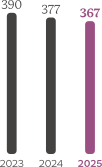
This bar chart presents L'Oréal's commitment to invest in operations (production and supply chain commitments) in €millions, over three consecutive years.
- 2023: €390m
- 2024: €377m
- 2025: €367m
PRODUCTION AND SALES OF THE OPERATIONAL DIVISIONS BY REGION IN 2025: PRODUCTION CLOSE TO ITS MARKETS
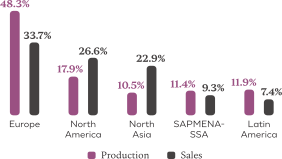
This chart illustrates the production and sales of the operational divisions by region in 2025: production close to its markets.
Production
- Europe: 48.3%
- North America: 17.9%
- North Asia: 10.5%
- SAPMENA-SSA: 11.4%
- Latin America: 11.9%
Sales
- Europe: 33.7%
- North America: 26.6%
- North Asia: 22.9%
- SAPMENA-SSA: 9.3%
- Latin America: 7.4%
1.3.5 Continuous transformation
L'Oréal continues its development by relying on its fundamental assets and transforming itself to respond to the new aspirations of consumers, employees and society, to become the company of the future.
"One L'Oréal": reconciling scale and agility
The Group places overwhelming emphasis on fostering cross-functionality throughout the organisation around a "One L'Oréal" backbone, while preserving teams’ agility and autonomy. "Scale and agility" is the underlying mantra of this vision, which involves pooling some of the organisation's resources.
In particular, L'Oréal intends to equip itself with state-of-the-art, secure information systems (NEO project) to ensure Group processes are standardised and simplified, and to support all its businesses and functions in a digital world. With this in mind, the Group is pushing ahead with the creation of shared service centres to capitalise on the use of big data and free up time for local teams.
More streamlined structures have enabled L’Oréal to:
- simplify the organisation, by creating six internal shared service centres and nine geographic clusters. An operating profit and loss account has been set up for each cluster, thereby reducing the reporting burden;
- perform an annual review of each Division's portfolio;
- simplify the catalogue for each brand, reducing the complexity of Research & Innovation.
Artificial intelligence
L'Oréal sees artificial intelligence (AI) as a key driver of its transformation and competitive advantage. The Artificial Intelligence strategy is holistic and based on three pillars: putting AI at the service of (i) consumers (diagnostics, recommendations, online retail), (ii) L'Oréal's business lines (R&I, Operations, Digital Marketing and media management) and (iii) its employees. This is illustrated by the following examples.