
SELECTING NEW DIRECTORS
The procedure for selecting new Directors is described in Article 5.3.1. of the Internal Rules of the Board of Directors, which is reproduced in full in section 2.3.6.
Selection process for new independent Directors appointed by the General Meeting
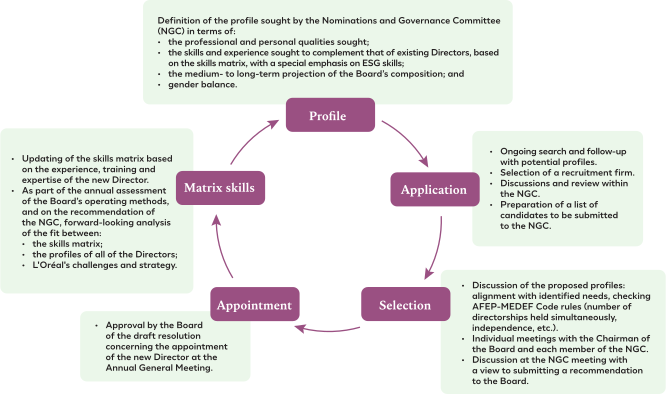
This diagram presents the selection process for new independent Directors appointed by the General Meeting, structured as a four-step cycle: Profile, Application, Selection, Appointment, and Matrix skills.
Profile
Definition of the profile sought by the Nominations and Governance Committee (NGC) in terms of: the professional and personal qualities sought; the skills and experience sought to complement that of existing Directors, based on the skills matrix, with a special emphasis on ESG skills; the medium- to long-term projection of the Board's composition; and gender balance.
Application
This step includes: ongoing search and follow-up with potential profiles; selection of a recruitment firm; discussions and review within the NGC; and preparation of a list of candidates to be submitted to the NGC.
Selection
This step includes: discussion of the proposed profiles, alignment with identified needs, checking AFEP-MEDEF Code rules (number of directorships held simultaneously, independence, etc.); individual meetings with the Chairman of the Board and each member of the NGC; and discussion at the NGC meeting with a view to submitting a recommendation to the Board.
Appointment
Approval by the Board of the draft resolution concerning the appointment of the new Director at the Annual General Meeting.
Matrix skills
Updating of the skills matrix based on the experience, training and expertise of the new Director. As part of the annual assessment of the Board's operating methods, and on the recommendation of the NGC, forward-looking analysis of the fit between: the skills matrix; the profiles of all of the Directors; and L'Oréal's challenges and strategy.
2.2.1.3 Two Directors representing employees
Two Directors representing employees have sat on the Board of Directors since 2014. Their experience as employees gives these two Directors an in-depth understanding of the business and the risks it faces, meaning they can enhance Board discussions in the interests of sustainable and long-term governance.
Thierry Hamel was appointed as a Director representing employees by the CFE-CGC union. He is a Project Manager for Sales Excellence, Onboarding and Training for the sales teams in the Professional Products Division in France.
Thierry Hamel has informed the Board that he intends to retire in 2026. The CFE-CGC union has therefore decided that, at the close of the 2026 General Meeting, it will appoint Catherine Olivry(1) as a Director representing employees for a four-year term. On her appointment to the Board, Catherine Olivry will become a member of the Human Resources and Remuneration Committee.
Benny de Vlieger was appointed as a Director representing employees by the European Works Council. He is a Sales Representative for the Consumer Products Division in Belgium. His term of office as a Director representing employees is due to expire at the close of the 2026 General Meeting.
The European Works Council has decided that, at the close of the 2026 General Meeting, it will re-appoint Benny de Vlieger as a Director representing employees for a further four-year term. Benny de Vlieger is a member of the Audit Committee.
As soon as they take up office, as is the case for all L'Oréal Directors, new Directors representing employees are given a tailored induction and support programme that includes privileged interactions, in particular with the Chairman of the Board, the Chief Executive Officer, the Chairman of the Nominations and Governance Committee and the Board Secretary.
Directors representing employees are entitled to training and are offered a personalised programme so they can supplement their knowledge of the business, understand the requirements of being a Director and make preparations to join one of the Board's specialised Committees.
Directors representing employees are remunerated for their duties according to the same distribution rules as other Directors. The components of their remuneration as employees are not published.